
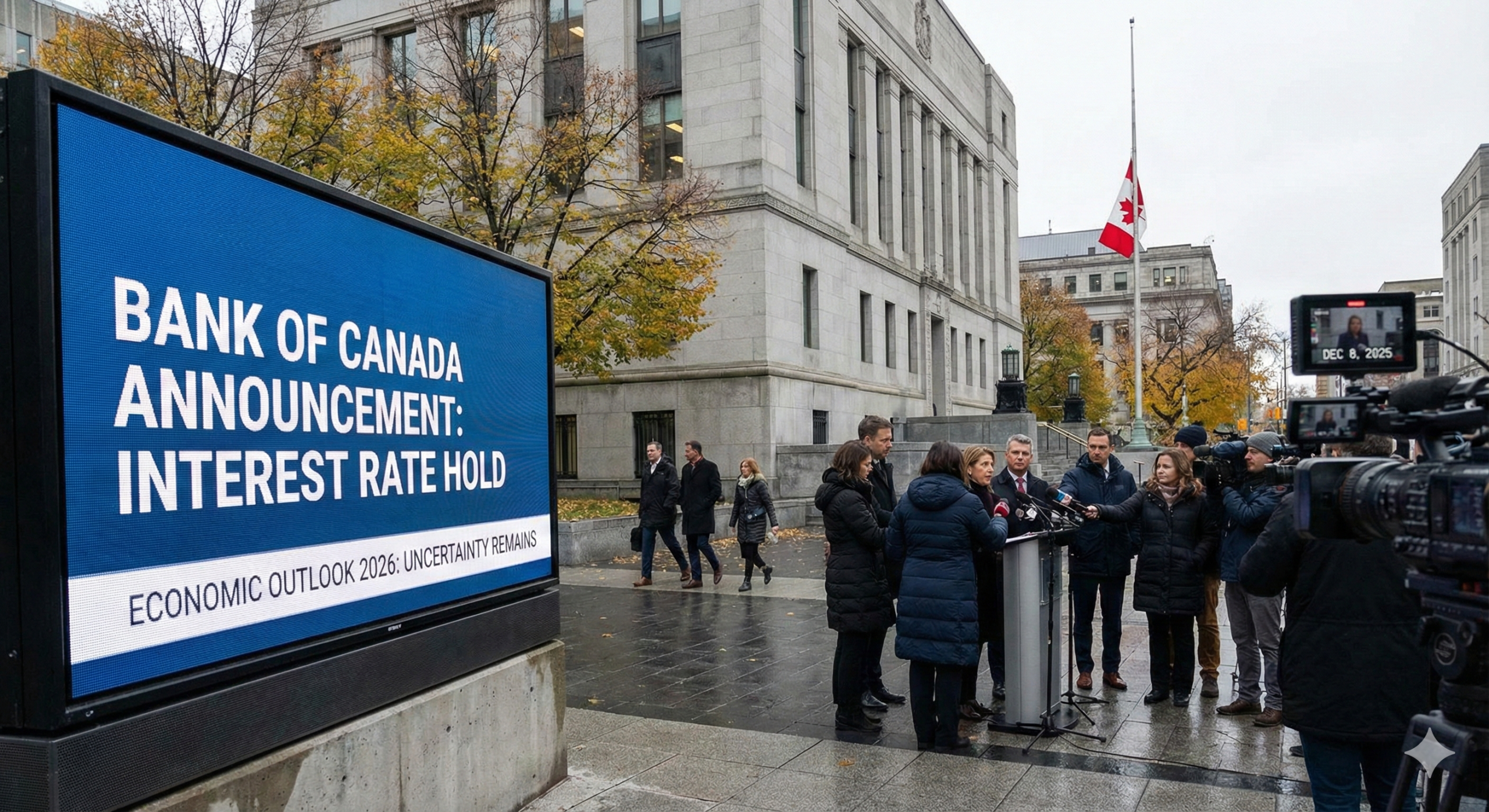
OTTAWA — Canada’s central bank is widely expected to stand pat on interest rates at its final policy meeting of the year, as economists and financial markets alike anticipate a pause after a year shaped by global trade tensions, unpredictable economic signals, and a careful balancing act between growth and inflation control.
The Bank of Canada’s benchmark interest rate currently sits at 2.25 per cent, marking a full percentage point decline from where it began at the start of 2025. Following four interest rate cuts over the course of the year, the consensus among economists is that the bank will now move to the sidelines, taking stock of its recent actions and waiting for clearer economic signals before making any further changes.
Markets, too, reflect this expectation. As of Friday afternoon, analysts were placing roughly a 93 per cent probability on the central bank holding rates steady, according to data from financial analytics firm LSEG.
Evidence of Economic Resilience Strengthens the Case for a Hold
Several unexpected signs of strength in the Canadian economy have reinforced the belief that further rate cuts are not imminent. Recent Statistics Canada employment reports came in stronger than anticipated, pointing to a labour market that remains more resilient than many experts had forecast several months ago.
Additionally, the Canadian economy posted an annualized real GDP growth rate of 2.6 per cent in the third quarter, surprising observers who had predicted a more muted performance. This data suggested that, despite ongoing pressures from global trade disruptions and rising costs, economic activity has not deteriorated as sharply as feared.
“Pulling these strands together, there is now no doubt the bank will stand aside,” said Doug Porter, chief economist at BMO, in a note to clients, summarizing the prevailing mood in the financial community.
While caution has been the dominant theme of 2025, these more positive indicators gave policymakers reason to step back and reassess rather than continue cutting rates.
A Year Marked by Carefully Timed Rate Moves
The Bank of Canada began 2025 with a clear strategy to stimulate the economy. It cut rates in January and March, showing early concern over slowing momentum and external economic risks. These initial reductions were followed by a prolonged pause during the spring and summer months as the bank sought clearer insight into the impacts of international trade developments—especially the evolving tariff dispute with the United States.
In September and October, the central bank returned to rate reductions, implementing two additional quarter-point cuts. By the time of its October announcement, policymakers suggested that the policy rate was approaching a level that might be sufficient to support the economy, provided no dramatic economic changes occurred.
At that time, the bank hinted that it could be satisfied with the current setting unless future data deviated significantly from its projections.
Trade Tensions Complicate Economic Forecasting
One of the biggest challenges for Bank of Canada policymakers throughout 2025 has been the complicated and shifting landscape of North American trade. New tariffs imposed by the United States—and Canada’s own retaliatory measures—introduced uncertainty into supply chains, business investment decisions, and overall pricing structures.
For much of the year, the central bank avoided issuing a single, clear economic forecast. Instead, it published multiple scenarios outlining different possible outcomes for inflation and economic growth, depending on how trade relations and tariffs unfolded.
Governor Tiff Macklem repeatedly noted that this level of uncertainty made traditional forecasting more difficult than usual.
“I think the Bank of Canada did act prudently through this period of heightened uncertainty,” said Randall Bartlett, deputy chief economist at Desjardins. The cautious approach, he suggested, helped avoid overreacting to what could have been temporary distortions from trade-related disruptions.
Balancing Risks of Inflation and Slowing Growth
While slowing economies typically reduce inflationary pressure, tariffs created a unique complication. Higher import costs and supply chain restructuring forced some companies to pass costs onto consumers, exerting upward pressure on prices at the same time that economic growth was weakening.
This unusual combination raised concerns about a potential stagflationary shock—a scenario where inflation rises even as economic growth stalls.
“The Bank of Canada found itself at a bit of a crossroads, where it was heading toward a stagflationary shock, which combines weak growth and higher inflation,” Bartlett explained.
Unsure whether inflation might spike rather than ease, the central bank avoided aggressive rate cuts during the middle of the year. Holding rates steady through the spring and summer was seen as a defensive move while officials waited for clearer inflation data.
Return to Clearer Forecasts Late in the Year
After cutting rates for a second consecutive time in October, the Bank of Canada returned to publishing more traditional economic projections. It estimated that Canada’s economy likely grew at just 0.75 per cent in the second half of 2025, reinforcing concerns that overall momentum remained weak.
However, the bank also forecast a modest recovery in the years ahead, suggesting that the most difficult period may soon pass, provided there are no further major shocks to the global trade system.
Bartlett believes the half-point of total rate cuts in the latter part of the year may have been sufficient to stabilize the economy during a turbulent transition period.
“With the cuts already delivered, the central bank is probably satisfied with where things stand for now,” he said.
Fiscal Policy Expected to Play a Larger Role in 2026
Another important development is the passage of the federal budget, which includes targeted measures aimed at supporting households, businesses, and vulnerable sectors of the economy. With fiscal policy now more firmly in place, economists believe the Bank of Canada may feel less pressure to continue adjusting monetary policy.
In other words, Ottawa’s spending and tax decisions are now expected to shoulder more of the burden in stimulating economic activity, allowing the central bank to remain on the sidelines.
“We’re expecting the Bank of Canada to stay on hold at its December meeting, and we expect the Bank of Canada to remain on hold throughout 2026,” Bartlett said, underlining the growing consensus among analysts.
Questions Remain About the Future of Inflation Measurement
Looking ahead, one area that will draw increased attention is how the Bank of Canada measures underlying inflation. Earlier this year, central bank officials acknowledged that the metrics they rely on may have been distorted by one-time changes, including tariffs and policy shifts such as the removal of the consumer carbon price.
These disruptions introduced noise into the data, making it harder to determine the true direction of inflation. As Canada approaches 2026 — when the central bank’s mandate will be reviewed — economists are eager to see whether revised or refined measures will be adopted.
Bartlett said he will be watching closely to understand how the bank plans to adjust its tools to better reflect real-world price pressures after a year of significant upheaval.
Conclusion: A Cautious Pause After a Turbulent Year
The story of the Bank of Canada in 2025 has been one of caution, flexibility, and adaptation in the face of unpredictable forces. From shifting trade policies to unexpected economic data, policymakers have been forced to navigate an unusually complex environment.
By holding the interest rate steady at 2.25 per cent, the central bank is signaling that it believes its recent actions have struck a reasonable balance—offering support to the economy while guarding against unexpected inflation.
You may also like



Leave a Reply