
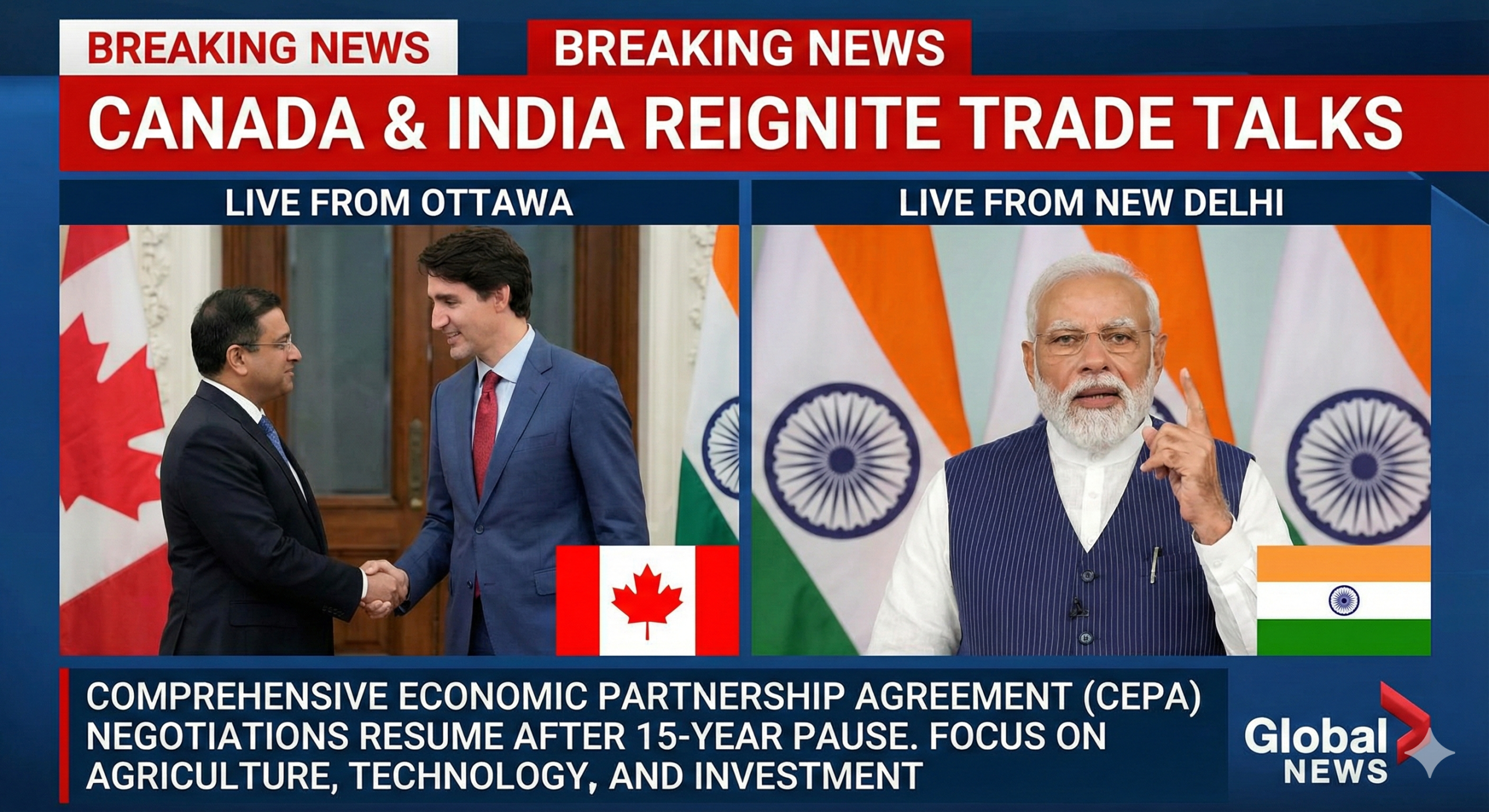
Canada and India have formally revived long-stalled negotiations for a wide-ranging trade agreement, marking a significant step toward resetting economic relations between the two countries after years of diplomatic tension and interrupted dialogue. The renewed push for a Comprehensive Economic Partnership Agreement (CEPA) follows discussions between Canadian Prime Minister Mark Carney and Indian Prime Minister Narendra Modi on the sidelines of the G20 summit in Johannesburg, where both leaders signaled a shared commitment to strengthening bilateral ties and accelerating cooperation across key sectors.
The announcement has been positioned as a turning point in Canada-India relations, with officials emphasizing the importance of trade diversification, strategic investment, and collaboration in emerging technologies. While past efforts were derailed by political and security concerns, the latest move suggests a mutual recognition that sustained economic engagement is essential in an increasingly volatile global trade environment.
A Renewed Commitment to Comprehensive Economic Cooperation
Foreign Affairs Minister Anita Anand confirmed that the two leaders agreed to officially relaunch negotiations for a Comprehensive Economic Partnership Agreement, a long-anticipated framework intended to deepen economic integration between Canada and India. According to Anand, the agreement will go far beyond traditional trade in goods, incorporating a broad range of modern economic priorities.
The proposed CEPA is expected to include provisions covering trade in goods and services, investment flows, agriculture, digital trade, labour mobility, and sustainable development, among other critical areas. The scope of the agreement reflects the evolving nature of global commerce, where technology, innovation, and environmental considerations are now integral to economic policy.
Anand stated that the negotiations would begin as soon as possible, underscoring the urgency both governments have placed on moving the process forward. She noted that the objective is not only to revive discussions but to conclude the agreement efficiently, signaling a clear departure from the prolonged delays that characterized previous attempts.
Focus on Speed and Strategic Outcomes
Describing the renewed effort as one driven by “alacrity,” Anand highlighted that both Prime Ministers are keen to ensure the CEPA progresses without unnecessary setbacks. The emphasis on urgency indicates a strategic shift, with Canada and India seeking to capitalize on growing global demand for resilient supply chains and diversified trade partnerships.
This approach also aligns with broader efforts by both nations to adapt to changes in the global economic order, where geopolitical shifts and trade realignments are redefining traditional alliances.
Historical Context: From Ambition to Stalemate
Canada and India first launched negotiations for a comprehensive trade deal in 2010, envisioning an agreement that would significantly boost bilateral trade and investment. However, progress proved slow and complex, with talks eventually scaled back to focus on a more limited, sector-specific arrangement targeting select industries.
By the fall of 2023, even these narrowed discussions were suspended following heightened diplomatic tensions. The Canadian government publicly alleged that the Indian government was linked to the assassination of a Sikh activist in British Columbia, an accusation that deeply strained relations. The situation was further complicated by claims of coercion, extortion, and foreign interference, which prompted Ottawa to halt trade negotiations as part of a broader reassessment of its engagement with New Delhi.
These developments cast a long shadow over bilateral relations, making the current revival of talks all the more significant.
Rebuilding Trust Amid Security Concerns
Despite past disputes, Prime Minister Carney has emphasized that Canada and India continue to maintain a security dialogue aimed at preserving sovereignty, sharing intelligence, and rebuilding mutual trust. Speaking ahead of his meeting with Modi, he stressed the importance of vigilance in addressing any form of foreign interference while acknowledging that India remains a dependable trade partner.
Carney’s remarks underscored the delicate balancing act both countries face — advancing economic cooperation while remaining firm on national security and democratic principles.
Expanding Trade and Investment Opportunities
One of the key drivers behind the renewed negotiations is the shared ambition to significantly expand bilateral trade. Officials from both sides have expressed confidence that two-way trade could double by 2030, reaching an estimated value of US$50 billion.
Currently, Canada ranks as India’s seventh-largest trade partner for goods and services and stands among the most significant foreign investors in the Indian market. Canadian companies have long been active in sectors such as infrastructure, clean energy, education, and financial services, while Indian firms continue to expand their presence in Canada across technology, manufacturing, and professional services.
Broad Economic Impact Across Multiple Sectors
The proposed CEPA is expected to unlock new opportunities for businesses and investors in both countries. By reducing trade barriers and streamlining regulatory frameworks, the agreement could enhance market access, encourage innovation, and create jobs across diverse industries.
Agriculture, for instance, could benefit from improved export conditions and stable supply chains, while digital trade provisions are likely to support cross-border e-commerce and data-driven services. Labour mobility measures may also allow for greater movement of skilled professionals, reinforcing collaboration in sectors such as information technology, healthcare, and engineering.
Cooperation in Advanced Technologies and Artificial Intelligence
Beyond traditional trade, discussions between Carney and Modi also focused on future-oriented sectors, particularly artificial intelligence and digital innovation. Anand noted that both leaders expressed a strong mutual interest in advancing AI capabilities and harnessing emerging technologies to drive economic growth and competitiveness.
This collaboration reflects a broader trend in global trade policy, where technological cooperation is increasingly seen as a strategic priority. Canada and India are positioning themselves to work together in areas such as AI research, cybersecurity, fintech, and digital infrastructure, all of which play a crucial role in shaping the modern economy.
Trilateral Agreement on Advanced Technologies
In a related development, Canada recently joined a trilateral agreement with India and Australia focusing on advanced technologies. This partnership is aimed at strengthening cooperation in high-value sectors and fostering innovation through shared expertise and joint initiatives.
The agreement is seen as a strategic move to enhance technological resilience and reduce reliance on traditional technology hubs, further reinforcing the need for diversified global partnerships.
Diplomatic Engagement and Future Visits
As part of the broader effort to rebuild relations, Prime Minister Carney is expected to visit India next year, although no specific timeline has been confirmed. One potential occasion for the visit is a planned AI summit in New Delhi, where Canada is leading a working group focused on responsible and innovative use of artificial intelligence.
Such a visit would symbolize a renewed commitment to engagement and could provide additional momentum for the CEPA negotiations. High-level diplomatic exchanges are likely to play a key role in sustaining dialogue and resolving outstanding issues.
Shared Global Challenges and Economic Priorities
Minister Anand highlighted that both countries currently face similar concerns, including economic uncertainty, geopolitical instability, and the need to secure strategic investments. She emphasized that attracting investments to strengthen the Canadian economy remains a central focus, especially as global trade patterns continue to evolve.
The realignment of the global trading order, coupled with increased geopolitical volatility, has made it imperative for nations to seek stable and reliable partners. In this context, Canada and India see renewed cooperation as a means to safeguard economic interests and enhance long-term resilience.
Conclusion: A Strategic Reset with Long-Term Implications
The revival of negotiations for a Canada-India Comprehensive Economic Partnership Agreement marks a pivotal moment in bilateral relations, reflecting both pragmatism and ambition. While past tensions underscored the fragility of diplomatic and trade ties, the renewed commitment demonstrates a shared willingness to move forward with a future-focused agenda.
By prioritizing economic collaboration, technological innovation, and strategic investment, both nations are positioning themselves to benefit from a more integrated and balanced partnership. If successfully concluded, the CEPA could not only double trade volumes by 2030 but also set a new benchmark for cooperation in a rapidly changing global landscape.
As talks resume and diplomatic engagement deepens, the evolving relationship between Canada and India will be closely watched, offering insights into how nations can reconcile complex political realities with the necessity of sustained economic growth and international collaboration.



Leave a Reply