
A Diplomatic Thaw with Major Implications for Waterloo Region
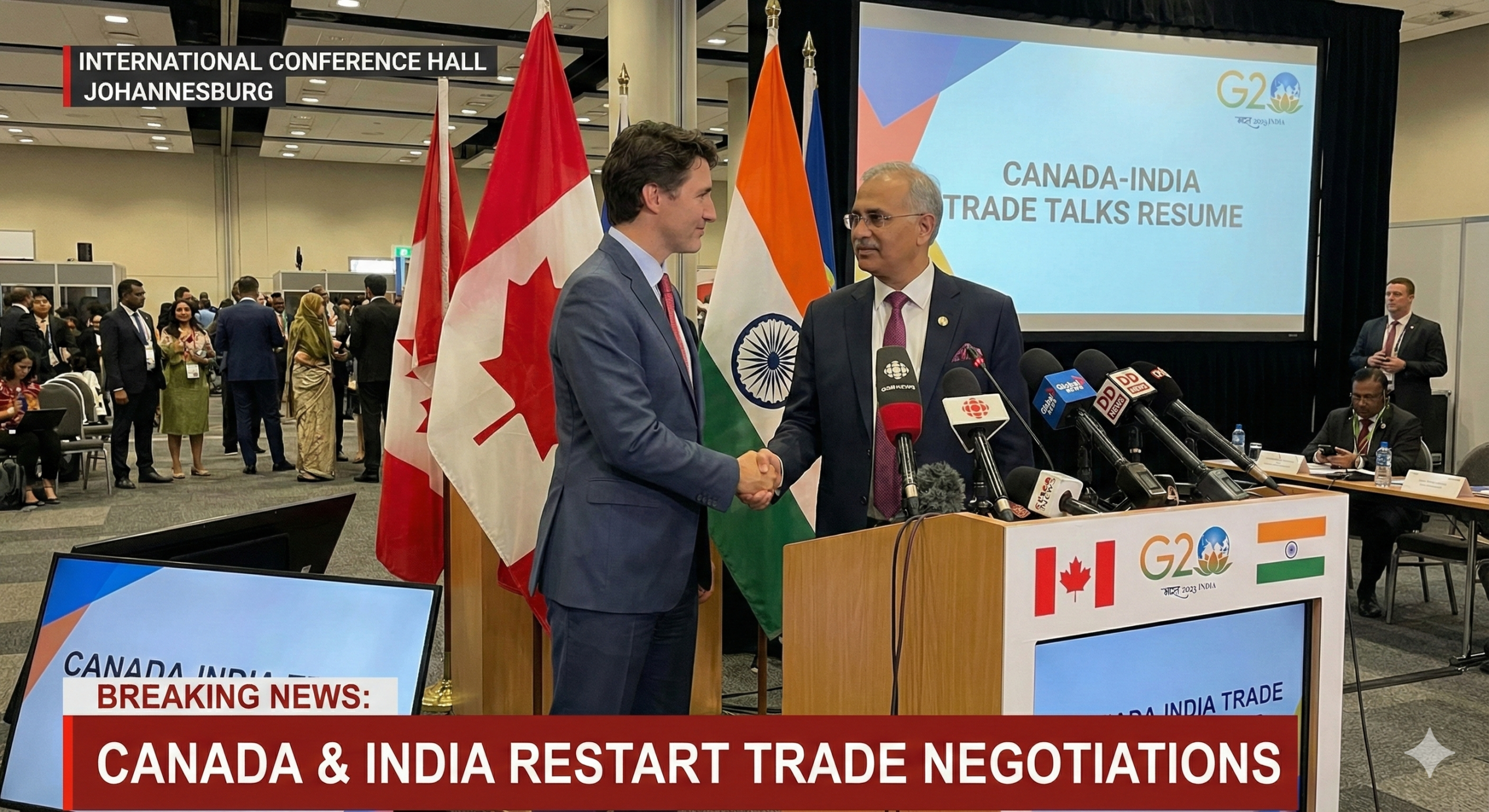
After a frosty two-year diplomatic hiatus and a fifteen-year saga of stop-and-start negotiations, Canada and India are officially back at the table. On Sunday, Prime Minister Mark Carney and Indian Prime Minister Narendra Modi announced the revival of talks for a Comprehensive Economic Partnership Agreement (CEPA) during a high-stakes bilateral meeting at the G20 summit in Johannesburg, South Africa.
For the residents and business owners of Kitchener, this announcement signals more than just a shift in international relations; it represents a potential economic watershed. With the Waterloo Region firmly established as a global corridor for artificial intelligence and advanced manufacturing, the renewal of these talks—specifically their focus on digital trade and labour mobility—has landed with significant weight in local boardrooms and community centres alike.
Foreign Affairs Minister Anita Anand, speaking from Johannesburg, confirmed that the leaders have agreed to formally launch negotiations “as soon as possible.” The proposed deal is ambitious in scope, covering goods, services, investments, agriculture, and—crucially for Kitchener’s “Silicon Valley of the North” identity—digital trade and sustainable development.
The Focus on AI and Digital Innovation
One of the most striking elements of the announcement for Kitchener’s local economy is the specific emphasis on artificial intelligence. According to Minister Anand, Prime Minister Carney and Prime Minister Modi dedicated a significant portion of their discussion to “their mutual interest in furthering advancements in the use of AI and digital technology more generally.“
For the tech sector in downtown Kitchener, heavily anchored by hubs like Communitech and major players such as Google, this alignment offers a promising new horizon. Enhanced digital trade provisions could streamline the flow of data and services between the two nations, opening the vast Indian market to Canadian software solutions and AI innovations developed right here in Ontario.
“The focus right now is on ensuring that we are securing investments that bolster the Canadian economy,” Anand stated. “Both countries are well aware of the fact that the global trading order is being realigned.”
Labour Mobility and International Talent
Beyond the transfer of technology, the prospective CEPA deals with the movement of people. The inclusion of “labour mobility” in the negotiation framework is of particular interest to Kitchener’s post-secondary institutions, including Conestoga College and the nearby University of Waterloo. Both institutions attract a significant number of international students and researchers from India. A formalized framework for labour mobility could simplify visa processes for high-skilled workers, ensuring that the local tech and engineering sectors continue to have access to a top-tier global talent pool.
From Diplomatic Freeze to “Moving with Alacrity”
The road to this announcement has been anything but smooth. Negotiations for a comprehensive deal initially began in 2010 but languished for over a decade. By the fall of 2023, talks had been downgraded to a limited “sectoral deal” before collapsing entirely.
The suspension of talks in 2023 marked a low point in Canada-India relations, triggered when Ottawa went public with RCMP allegations linking agents of the Indian government to the assassination of a Sikh activist near Vancouver. The fallout included allegations of coercion and extortion, leading to a diplomatic deep freeze that halted all trade conversations.
Addressing Security and Rebuilding Trust
Prime Minister Carney addressed these lingering tensions directly at a news conference ahead of his meeting with Modi on Sunday. He insisted that while trade is vital, security and sovereignty remain non-negotiable.
“With respect to any forms of foreign interference, we have to remain vigilant — we are vigilant,” Carney asserted. He emphasized that Canada and India are maintaining a security dialogue to share information and rebuild the trust that was fractured two years ago.
Despite the gravity of past accusations—and a federal inquiry earlier this year that branded New Delhi as a significant perpetrator of foreign interference—Carney described India as a “reliable trade partner,” acknowledging that occasional disputes are part of complex international relationships. This pragmatic pivot suggests a “dual-track” approach, where economic cooperation proceeds alongside robust security vigilance.
Minister Anand echoed this sentiment, noting the urgency with which both leaders are approaching the renewed talks. “The leaders are both moving with alacrity to ensure that this CEPA is concluded as soon as possible,” she said.
A New Trilateral Alignment
Adding another layer to this geopolitical reset, Canada officially joined a trilateral agreement with India and Australia on Saturday. This pact focuses specifically on advanced technologies, further cementing the link between Kitchener’s innovation ecosystem and the Indo-Pacific region. This move places Canada in a strategic position to collaborate with two other major Commonwealth democracies on critical tech standards and supply chains, reducing reliance on less stable markets.
Economic Forecast: Doubling Trade by 2030
The economic targets attached to this revived negotiation are aggressive. Minister Anand revealed that both countries expect to double two-way trade by 2030, aiming for a target of US$50 billion.
Currently, Canada is India’s seventh-largest trade partner for goods and services. For Kitchener’s manufacturing base—ranging from automotive parts to food processing—reduced tariffs and better market access could be a game-changer. The inclusion of agriculture in the talks is also notable for the broader rural townships surrounding Waterloo Region, which rely heavily on export markets.
Local Reactions and Future Outlook
While business leaders may welcome the news, the local reaction in Kitchener is likely to be mixed, reflecting the diverse views of the city’s large South Asian diaspora. The diplomatic row of 2023 deeply affected many in the community, and the promise of a trade deal may be viewed through a lens of caution regarding human rights and transnational repression.
However, the economic momentum appears difficult to halt. Prime Minister Carney is tentatively scheduled to visit India next year to further these initiatives. While a specific date has not been confirmed, a potential summit on Artificial Intelligence in New Delhi next February is being eyed as a likely venue. With Canada leading a working group for this summit, it would provide a high-profile platform to showcase Canadian—and specifically Waterloo Region—AI leadership.
Conclusion: Navigating a Volatile World
As negotiations officially recommence, the atmosphere is one of cautious optimism tempered by geopolitical reality. The “volatility in the geopolitical environment,” as noted by Minister Anand, is conspicuous. By diversifying trade partnerships and re-engaging with the world’s fifth-largest economy, Ottawa is attempting to insulate Canada from global instability.
For Kitchener, the coming months will be critical. If a Comprehensive Economic Partnership Agreement is indeed signed, the region stands to benefit disproportionately from new avenues for digital trade, skilled labour mobility, and advanced manufacturing exports. After fifteen years of waiting, the finish line may finally be in sight, provided the delicate balance between economic ambition and national security can be maintained.
You may also like



Leave a Reply