
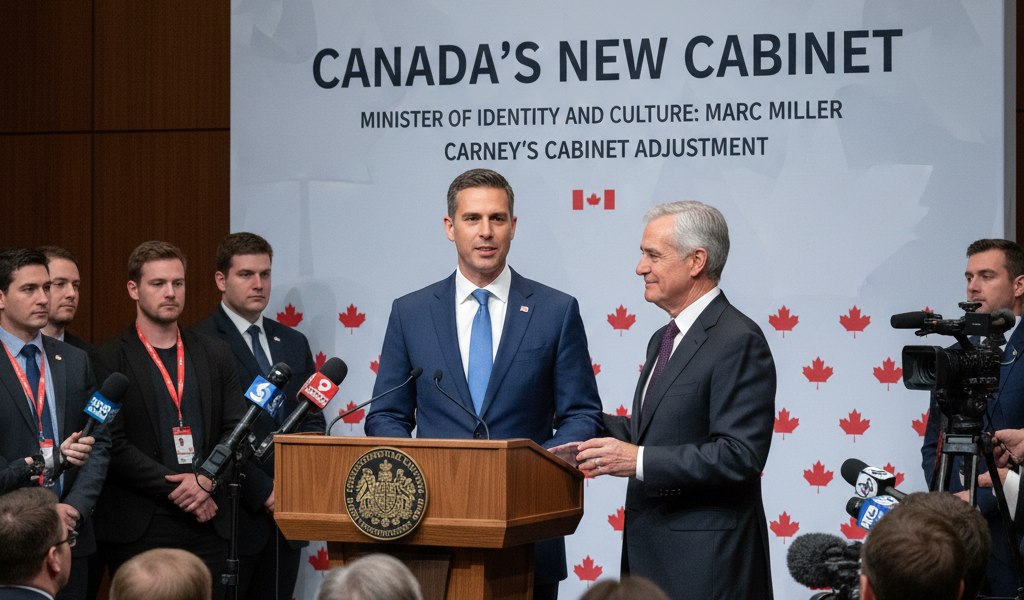
Prime Minister Mark Carney has appointed Montreal MP Marc Miller as Canada’s new Minister of Canadian Identity and Culture in a targeted cabinet reshuffle aimed at filling vacancies created by the recent resignation of Steven Guilbeault. The change, confirmed during a swearing-in ceremony at Rideau Hall on Monday, marks a significant shift in leadership at a time when cultural policy, digital regulation, and national identity are under increasing domestic and international scrutiny.
Miller will also assume the role of Minister responsible for Official Languages, expanding his responsibilities in a portfolio that is now expected to play a central part in shaping Canada’s cultural identity in a rapidly evolving political and technological environment.
The small but meaningful cabinet shuffle highlights Prime Minister Carney’s efforts to stabilize his government’s agenda following Guilbeault’s departure and to reposition key ministries as Canada faces new economic, environmental, and trade challenges.
Guilbeault’s Exit Triggers Strategic Cabinet Changes
Steven Guilbeault stepped down from cabinet last week after the federal government signed a new energy agreement with Alberta that clears the way for the development of a proposed oil pipeline to the British Columbia coast. Although Guilbeault remains a Liberal Member of Parliament, his resignation signaled growing tensions inside the party over Canada’s future direction on environmental policy and energy development.
Guilbeault’s Influence on Environmental and Cultural Policy
Before Carney assumed the role of prime minister, Guilbeault served for four years as Canada’s environment minister. During that time, he became one of the most recognizable faces of the country’s climate agenda. He was also Canada’s heritage minister from 2019 to 2021, overseeing major cultural and media-related initiatives.
Under Justin Trudeau’s government, the heritage ministry was heavily focused on regulating large American technology companies. Through legislation, the government sought to require digital platforms to contribute financially to Canadian content creators and local news organizations. These efforts culminated in the introduction of the Online Streaming Act and the Online News Act, which were designed to re-balance the relationship between tech giants and Canada’s cultural industries.
Guilbeault returned to the cultural portfolio following this spring’s federal election, when the department was renamed Canadian Identity and Culture. However, the ministry’s purpose became less defined as Prime Minister Carney began moving away from aggressive tech regulation in favor of a new, more innovation-focused strategy.
Marc Miller Returns to a Familiar Role in Government
Marc Miller is no stranger to federal cabinet responsibilities. He previously served under former prime minister Justin Trudeau between 2019 and 2025 in several senior roles. After Carney formed his cabinet earlier this year, Miller was not initially included, leading to speculation about his future in government.
His reappointment now places him in a critical position at a pivotal moment.
Responsibilities Expand to Identity and Official Languages
In addition to becoming Minister of Canadian Identity and Culture, Miller will also take on the responsibility for official languages — a portfolio that plays a crucial role in maintaining Canada’s bilingual framework and ensuring that English and French are actively supported in government, education, and public life.
This dual appointment reflects the government’s approach to emphasize unity, national cohesion, and cultural representation while ensuring that linguistic rights remain protected.
Miller is expected to bring both experience and a more measured approach to the ministry as it redefines its mandate under Carney’s leadership.
Key Positions Shift as Carney Restructures Leadership in Quebec
The cabinet shuffle did not only impact the culture portfolio. Prime Minister Carney also made two additional changes, reinforcing his leadership presence in Quebec and environmental policy.
Joël Lightbound Named Quebec Lieutenant
Government Transformation Minister Joël Lightbound has been appointed as Carney’s new Quebec lieutenant, replacing Guilbeault in that role. This position is critical in maintaining the party’s strength and visibility in Quebec, where political dynamics often differ significantly from the rest of the country.
Lightbound’s appointment suggests that Carney is prioritizing communication and coordination in the province during a time when both cultural identity and resource development are top-of-mind issues for many Quebec voters.
Julie Dabrusin Takes Over the Nature Portfolio
Environment and Climate Change Minister Julie Dabrusin will now assume additional responsibility for the federal “nature” file, previously overseen by Guilbeault. This includes biodiversity protection, conservation efforts, and ecosystem management.
By delegating these duties to Dabrusin, Carney’s government is aiming to maintain continuity in environmental programs, even as the broader policy direction becomes more focused on balancing sustainability with energy and economic development.
Silence From Ministers Following Ceremony
The swearing-in ceremony at Rideau Hall took place on Monday afternoon, with Marc Miller formally stepping into his new role. However, none of the newly assigned ministers made themselves available to the media for questions following the ceremony.
The absence of commentary left many observers speculating about the government’s next steps, particularly regarding the future of legacy legislation introduced under the Trudeau era and the potential reshaping of Canada’s approach to digital and cultural policy.
Government Shifts Away From Tech Regulation
One of the most significant implications of Miller’s appointment is the possibility of a new approach to the regulation of technology companies operating in Canada.
Under the Trudeau government, the cultural ministry’s mandate was largely defined by its confrontation with American tech giants such as Google, Meta, and streaming services. The Online Streaming Act and Online News Act were central parts of that strategy, requiring platforms to contribute financially to Canadian content and compensate news outlets for sharing their material.
New AI Portfolio Creates Overlapping Responsibilities
Prime Minister Carney has created a separate ministerial portfolio dedicated exclusively to artificial intelligence. This move has introduced uncertainty about which ministry will take the lead on issues such as copyright reform, misinformation, and online harms.
Both the new AI minister and the justice minister are expected to introduce legislation addressing online safety. However, the Minister of Canadian Identity and Culture is also expected to play a key role in shaping how content, creativity, and media protection are handled in a fast-changing digital environment.
This overlap raises important questions about future jurisdiction and collaboration between departments.
Pressure From the United States Adds Complexity
Adding another layer of challenge to Miller’s new role is mounting pressure from the United States over Canada’s digital legislation. American officials and tech corporations have voiced strong opposition to the Online Streaming Act and the Online News Act, arguing that these laws unfairly target U.S.-based companies and could violate trade agreements.
As a result, Carney’s government faces a difficult balancing act. On one hand, it must demonstrate support for Canadian creators and media organizations. On the other, it must manage diplomatic and economic relations with the country’s largest trading partner.
Miller will likely play a central role in navigating these tensions, especially as calls grow louder for Canada to scale back or repeal the controversial measures.
A Defining Moment for Canada’s Cultural Vision
Miller is stepping into the role at a time when Canadian identity is being re-examined in the context of globalization, artificial intelligence, energy politics, and digital transformation. His leadership will influence not only traditional arts and media but also how Canada defines itself in a connected world where boundaries between culture, technology, and politics continue to blur.
Expectations From Artists, Media, and the Public
Cultural organizations, independent journalists, and creative workers will be watching closely to see whether Miller chooses to maintain the protectionist approach of the previous government or pivot toward a more open, innovation-focused model.
At the same time, Canadians across the country will likely expect clarity around:
-
The future of online content regulation
-
Support for Canadian artists and creators
-
Language rights and bilingual services
-
Protection of national identity in the digital age
The decisions made in the coming months could have a lasting impact on Canada’s cultural landscape for years to come.
Conclusion: A Portfolio Filled With Pressure and Possibility
Marc Miller’s appointment as Minister of Canadian Identity and Culture is far more than a simple cabinet rotation. It reflects a broader political recalibration under Prime Minister Mark Carney, who is seeking to adjust the tone, direction, and priorities of the federal government.
From the unfinished legacy of Steven Guilbeault to the rising importance of artificial intelligence and foreign pressure on domestic policy, Miller’s new role stands at the intersection of several of the most important debates facing Canada today.
As the government continues to define its path forward, one thing is clear: the future of Canadian culture, identity, and expression will now be shaped under new leadership — at a moment when those very ideas are being tested like never before.



Leave a Reply