
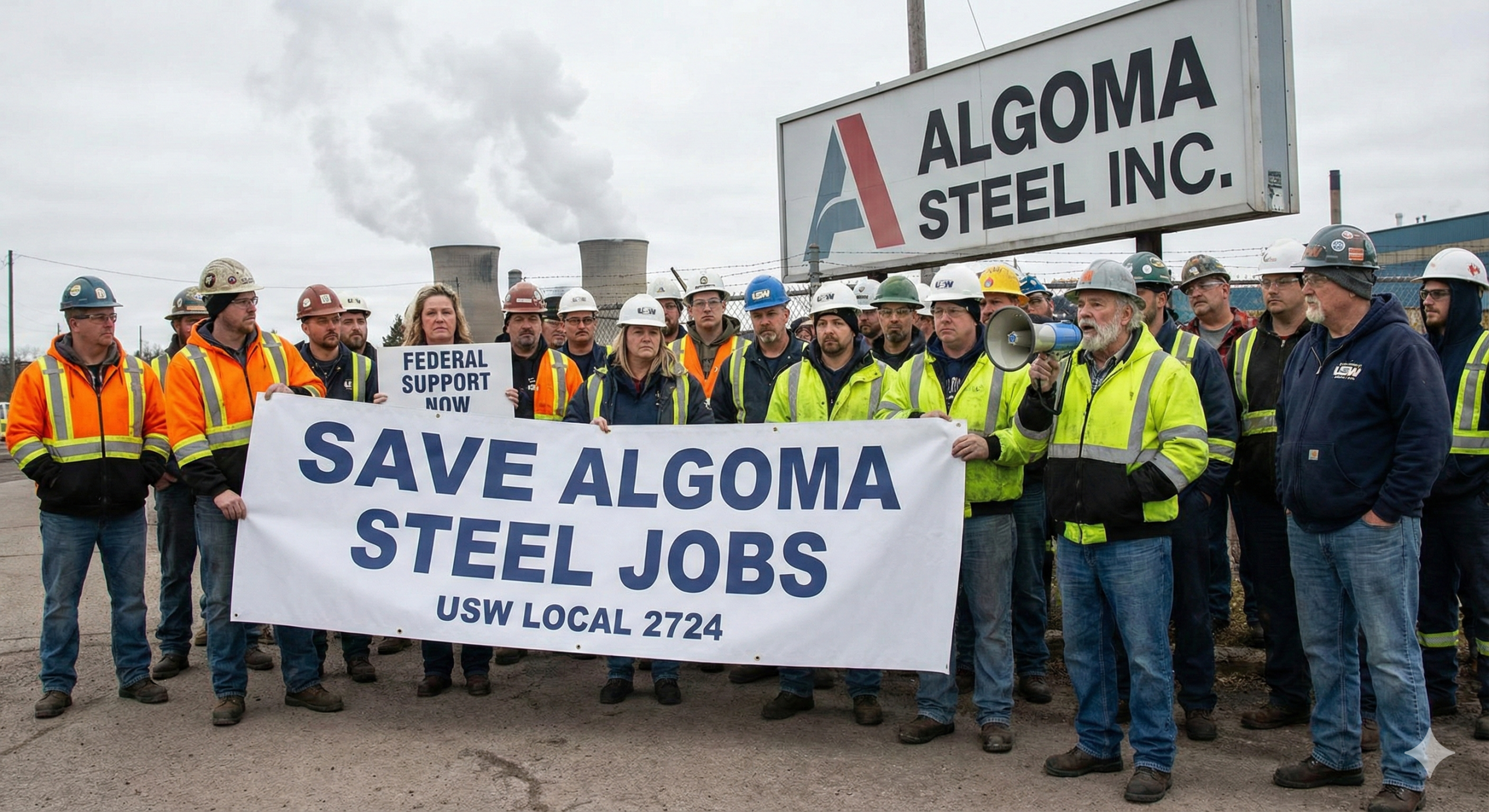
Efforts are intensifying to save hundreds of jobs at Algoma Steel Inc. in Sault Ste. Marie, where approximately 1,000 workers recently received layoff notices amid a major restructuring of the company’s production system. While uncertainty continues to cloud the steelmaker’s future, union officials say discussions with government representatives have opened the door to a potential lifeline that could restore a significant portion of the threatened positions.
The development comes as Algoma Steel seeks $500 million in federal assistance, citing ongoing financial instability tied to U.S. tariffs on Canadian steel and the costly transition to a new electric arc furnace production model. Though neither the federal government nor the company has formally confirmed the rescue plan, union leaders say there is reason for cautious optimism.
Hundreds of Jobs Could Be Saved, Union Says
Union President: Up to 500 Workers May Return by End of 2026
Bill Slater, president of United Steelworkers (USW) Local 2724, which represents many of the affected workers, says early discussions suggest that as many as 500 employees could be brought back to work by the end of next year. The optimism is tempered by uncertainty, but Slater says the union is encouraged by the momentum behind the effort.
According to Slater, the strategy would involve expanding production capacity at Algoma Steel—an initiative likely tied to federal loan support that would give the company financial breathing room during its structural transition.
“We’re hearing encouraging things,” Slater said. “There’s a plan being considered that could preserve about half of the jobs at risk, but the details are still being finalized. Until there’s concrete confirmation, our members are waiting anxiously to see what comes next.”
How the Job Losses Happened
Algoma Accelerates Shift to New Production System
The layoffs stem from Algoma Steel’s accelerated move toward a more efficient production process. The company is transitioning from its traditional blast furnace operations to a new electric arc furnace (EAF) system, a cleaner and more cost-effective technology widely adopted across the global steel industry.
However, the new system requires significantly fewer employees, leading the company to issue layoff notices to more than 1,000 workers just one week ago.
Impact of U.S. Tariffs Intensifies Financial Pressure
Algoma Steel’s financial challenges have been compounded by continuing U.S. tariffs on Canadian steel, which have restricted market access and reduced revenues. Earlier this year, the company revealed it was seeking $500 million in federal financing to help stabilize operations.
The combination of external trade pressures and the internal transition to EAF production has created a financial pinch, prompting the company to accelerate job cuts much faster than originally planned.
Federal Government’s Role: Still No Official Confirmation
Industry Minister’s Visit Sparks Optimism
The possibility of salvaging up to half of the threatened jobs began circulating after Industry Minister Mélanie Joly visited Sault Ste. Marie last Friday. During her trip, she met with representatives from Algoma Steel and the United Steelworkers, and later spoke briefly with reporters.
Local media outlets reported that an agreement—or at least a framework for one—was being explored, potentially including significant federal loan support aimed at expanding Algoma’s production capabilities.
However, despite repeated follow-up requests, neither the federal government nor Algoma Steel has confirmed specifics of the plan.
Union: Workers Waiting, Hoping for Clarity
Slater says that while the union is encouraged by the conversations that have taken place, nothing has been “set in stone.” Until the federal government and Algoma formally announce details, hundreds of workers will remain unsure whether they will return to the plant next year.
“Our members are understandably anxious,” Slater said. “They want to believe help is coming, but until there’s a signed agreement, everyone is still holding their breath.”
What the Rescue Plan Might Look Like
Government Loan Could Expand Capacity
Though official details have not been released, the potential job-saving plan appears to hinge on a federal loan package intended to help Algoma Steel expand production capacity during its transition to the electric arc furnace system.
This expansion could include:
-
Increasing the volume of steel production
-
Stabilizing operations during the transition
-
Supporting new processes or product lines
-
Investing in infrastructure upgrades
By boosting production capabilities, the company could reassign or rehire hundreds of workers rather than keeping operations scaled down for an extended period.
EAF Transition: Short-Term Pain, Long-Term Efficiency
The shift to electric arc furnace technology is expected to significantly reduce greenhouse gas emissions and modernize Algoma’s operations. However, the transition has created short-term disruptions, including:
-
Reduced operational output
-
Temporary shutdowns of production lines
-
The need to retrain staff
-
Fewer required labour hours overall
Government support would help bridge the financial gap during this transitional phase.
Local Impact and Community Concerns
Sault Ste. Marie Facing deep Uncertainty
Algoma Steel is one of the largest employers in Sault Ste. Marie, and news of over 1,000 job losses sent shockwaves through the community. Local businesses, municipal leaders, and economic development groups have warned that widespread layoffs could have a far-reaching economic ripple effect on the region.
Saving even half of the threatened jobs would provide significant relief to the local workforce and the broader community.
Economic Ripple Effects Already Being Felt
Restaurants, small businesses, and service providers dependent on steelworkers’ patronage say the uncertainty has already begun affecting spending patterns. A prolonged period of layoffs could deepen economic stress across the region.
Workers Remain Hopeful but Cautious
For now, the fate of the threatened jobs rests largely on ongoing discussions between Algoma Steel and the federal government.
Slater emphasizes that while optimism is growing, caution remains the prevailing sentiment among workers.
“Everyone wants to believe that help is coming,” he said. “But until we see the final agreement in writing, there’s still a lot of nervousness among our members.”
You may also like



Leave a Reply